
In chemistry, a free radical is an unstable molecule. It roams. It reacts. The chaos it creates forges unexpected bonds between atoms that would otherwise never connect. And in the process, it reshapes the entire material.
Donald Trump is a free radical in global politics.
I first drafted this article after the EU-India trade deal was announced last week. Trump and Modi announced a tariff framework of their own on Sunday. US reciprocal tariffs on India dropping from 25% to 18%. A $500 billion purchase commitment from India. Agriculture Secretary Brooke Rollins calling it a win for American farmers. Indian markets pumped on Monday as traders buzzed with excitement. Reliance surged since it has unique refinement abilities for Venezuela's crude.
The details are still blurry. India hasn't publicly confirmed the $500 billion figure. The opposition is creating a ruckus in parliament. But the pattern is unmistakable. One week after India closed a historic deal with the EU, the free radical moved to form its own bond. If anything, it only strengthens the thesis of this article.
Thank you @POTUS for ONCE AGAIN delivering for our American farmers.
— Secretary Brooke Rollins (@SecRollins) February 2, 2026
New US-India deal will export more American farm products to India's massive market, lifting prices, and pumping cash into rural America.
In 2024, America\u2019s agricultural trade deficit with India was $1.3\u2026 https://t.co/Z04eNDfXjD
On Inauguration Day, President Trump posted an AI-generated photo on Truth Social. Him, JD Vance, and Marco Rubio planting an American flag on Greenland. A sign in the image read: "Greenland. US TERRITORY EST. 2026."
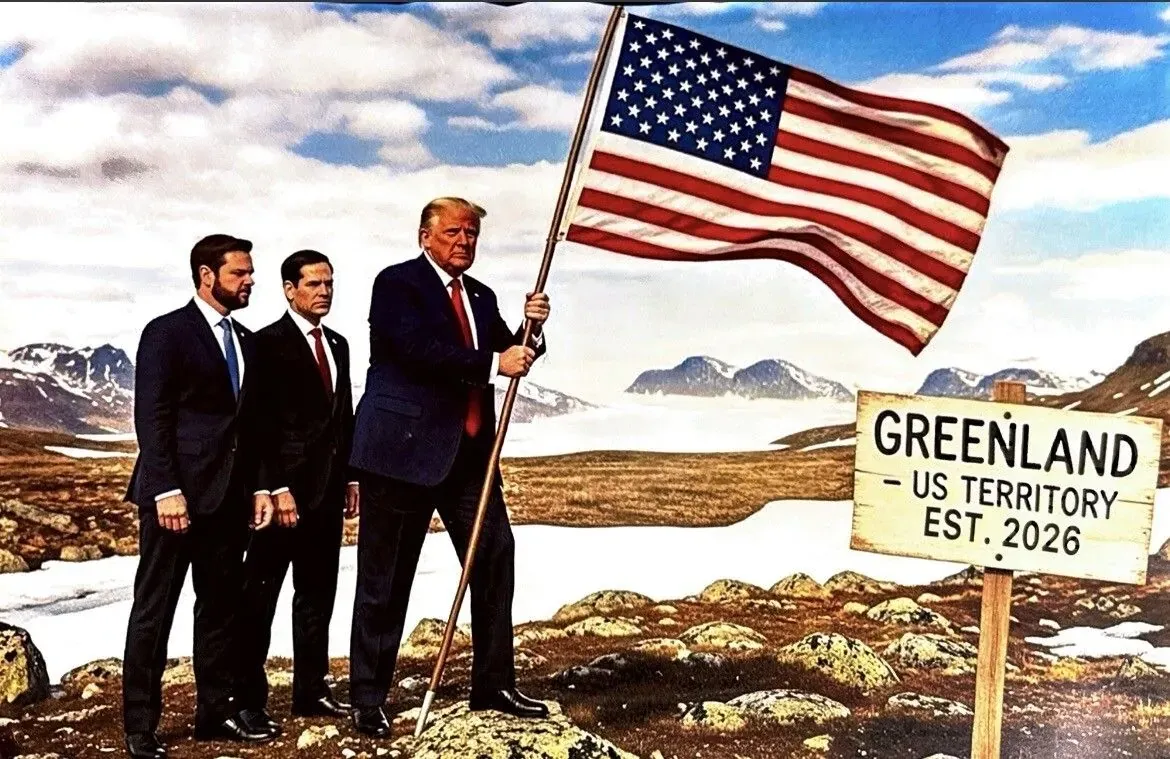
European leaders went into a tizzy. Emmanuel Macron texted Trump directly. The message leaked: "I do not understand what you are doing on Greenland." Denmark's prime minister told him to "stop the threats." Eight European nations warned of a "dangerous downward spiral" in transatlantic ties. France, Germany, Sweden, and Norway deployed troops to Greenland for joint exercises.
Then at Davos, Trump announced he had struck a "framework of a future deal" with NATO. Total US access to Greenland. Mineral rights. A missile defense system. Victory declared.
Except the deal was vague. Denmark confirmed nothing had been agreed. The "framework" looked a lot like the 1951 agreement the US already had. But Trump had created chaos, rode the wave, owned the news cycles, and walked away claiming a win. Classic free radical behavior. Small wins. Meaningful, no doubt. But the real effect? He's compelling nations to find bonds and explore partnerships that are completely redefining how countries approach politics.
Take the EU and India. Just a couple of days back, I noticed a small tell. Both Ursula von der Leyen and Antonio Costa were the main guests at India's Republic Day Parade in New Delhi. Two EU leaders at the same event. That's never happened before. And then I saw Antonio Costa initiate one of Prime Minister Modi's signature hugs. Almost instantly once he stepped out of his car. That told me something exciting was brewing. The EU was eager to build ties with India. Then the trade announcement only confirmed their hand.
The European Union inked a deal with India to slash tariffs. India, which has generally taken a protectionist stance, reciprocated by cutting duties on European goods dramatically. Wine tariffs dropped from 150% to 20-30%. Spirits from 150% to 40%. The EU estimates EUR 4 billion in annual savings.
Prices will fall. Supply chains will re-route. And quietly, a new world order is forming up and cross-linking. Strong bonds are forming between nations. Not despite Trump. Because of him.
Signals of a reorder
EU-India trade thaw. India cut tariffs on 96.6% of EU goods. The EU liberalized for 99.5% of Indian imports. This marks a shift from India's traditional protectionism and Europe's status quo.
NATO burden-sharing. For the first time since the 2014 guideline was set, all 32 NATO allies are meeting the 2% GDP defense spending target. Poland is leading at 54% equipment spending, more than double the 20% target. Three countries have hit 3.5%: Poland, Lithuania, Latvia. Whether you agree with the tactic or not, it's working.
Transactional diplomacy. From Greenland theater to pushing peace frames in the Middle East to the rare earths deal with Ukraine signed last April. Even fiber-linked drones changing modern warfare reflect how technology and geopolitics now move in lockstep. Trump turns foreign policy into transactional negotiation, centered on perceived US leverage and material interests. He sticks to his guns on "Make America Great Again," prioritizing America and Americans over America's global leadership role. That's what his base elected him to do. He's being true to his base. But he's triggering a series of dramatic events that is changing not just the politics of the world, but the economic climate and the way deals are struck and trade is done.
The middle powers' moment
At Davos last week, Canadian Prime Minister Mark Carney captured the mood. He framed it bluntly: the international order has experienced a rupture, not a transition.
His rallying cry to middle powers landed with force: "If we are not at the table, we are on the menu." (I loved this line, stealing it to spout it to founders exploring M&A!)
To most of us, Carney's speech was the most important thing that came out of the 56th World Economic Forum. It underscores the entire narrative forming around this kind of politics. Middle powers are networking across trade, tech, and security. They want optionality. They want resilience. They want deals that reflect their interests.
What this means for us in business
The primary takeaway is to adapt to the changing landscape and explore new avenues, new pathways, new bonds that are offering themselves as opportunities to the rest of us.
- Plan for volatility. Policy shocks and tariff pivots will continue. Build optionality into sourcing, logistics, and market entry.
- Follow the cross-links. New bilateral agreements are creating fresh lanes for trade, capital, talent, and tech transfer. Map alternative corridors to move your goods and services depending on shifting trade winds.
- Hedge the majors, bet on the middle. Diversify exposure to middle-power markets forming new coalitions. India, ASEAN states, Gulf economies, select African and Latin American hubs.
- Price geopolitical risk into deals. Treat political signals as core variables in valuation and contract design.
- Nationalism is now mainstream. Take a moment to digest that every nation is now operating in its self-interest and you can no longer afford to leave it out of your business plans.
We also need to keep in mind that some deals may hit some harder than others, and you cannot realistically grow a business while others struggle. I'm keeping a close eye on how Indian farmers react to these new deals.
The takeaway
In chemistry, free radicals are often seen as destructive. They cause oxidation, decay, damage.
But they also do something else: They create cross-links, foster new bonds, often build stronger materials.
Trump is causing plenty of oxidation. But the cross-links forming between nations right now may prove to be the more lasting effect. Middle powers are moving from spectators to center-stage deal-makers. New trade corridors are opening. Old protectionist walls are coming down.
For businesses, the play is clear: adapt early, track the bonds as they form, and build strategies that thrive in a world of shifting alliances. The free radical isn't going away. But the new bonds? They're just getting started.
Follow me on X for more thoughts on growth and marketing. Subscribe to my newsletter for new posts.