
Turns out, it was written in the stars.
Apple just announced that Siri's upcoming AI capabilities will be powered by Gemini. And like any good astrology reading, this one tells us a lot about compatibility, timing, and why some relationships just don't work out.
OpenAI had Apple. They had the integration. ChatGPT was already in Siri for complex queries. And they lost it anyway. If you're like me, you'd have already connected your ChatGPT account to Siri for meaningful responses rather than the "I found this on the web..." flub.
This new deal with Google is reportedly worth $1 billion per year. But the real story isn't about the money. It's what this tells us about winning and keeping marquee clients.
A Season of Code Reds
Here's another thing that fascinated me.
In 2023, I recollect Google declaring a "Code Red" because ChatGPT was eating their lunch, and Google stockholders were wondering why Google was content watching the AI race from the sidelines. Sundar Pichai redirected entire teams to catch up.
Fast forward to late 2025. Sam Altman declared Code Red at OpenAI because Gemini 3 was beating them on benchmarks. ChatGPT's active users were dropping while Gemini's were climbing.
The tables turned in under three years.
Altman admitted something remarkable: "If Google had really decided to take OpenAI seriously in 2023, we would have been in a really bad place. Google could have smashed us."
Being an early mover gives you an advantage. But you need to solve for the deeper, long-term, full-stack value chain to demonstrate long-term value for marquee brands.
Distribution trumps product
OpenAI had the best product for two years. It didn't matter.
Google is winning today because they own the full stack:
- The model (Gemini with 1.2 trillion parameters)
- The infrastructure (Google Cloud)
- The existing relationship (the Safari deal already worth billions)
- Corporate stability (profitable company, not burning VC money)
- The distribution (Search, Chrome, Workspace, Android, YouTube, and more)
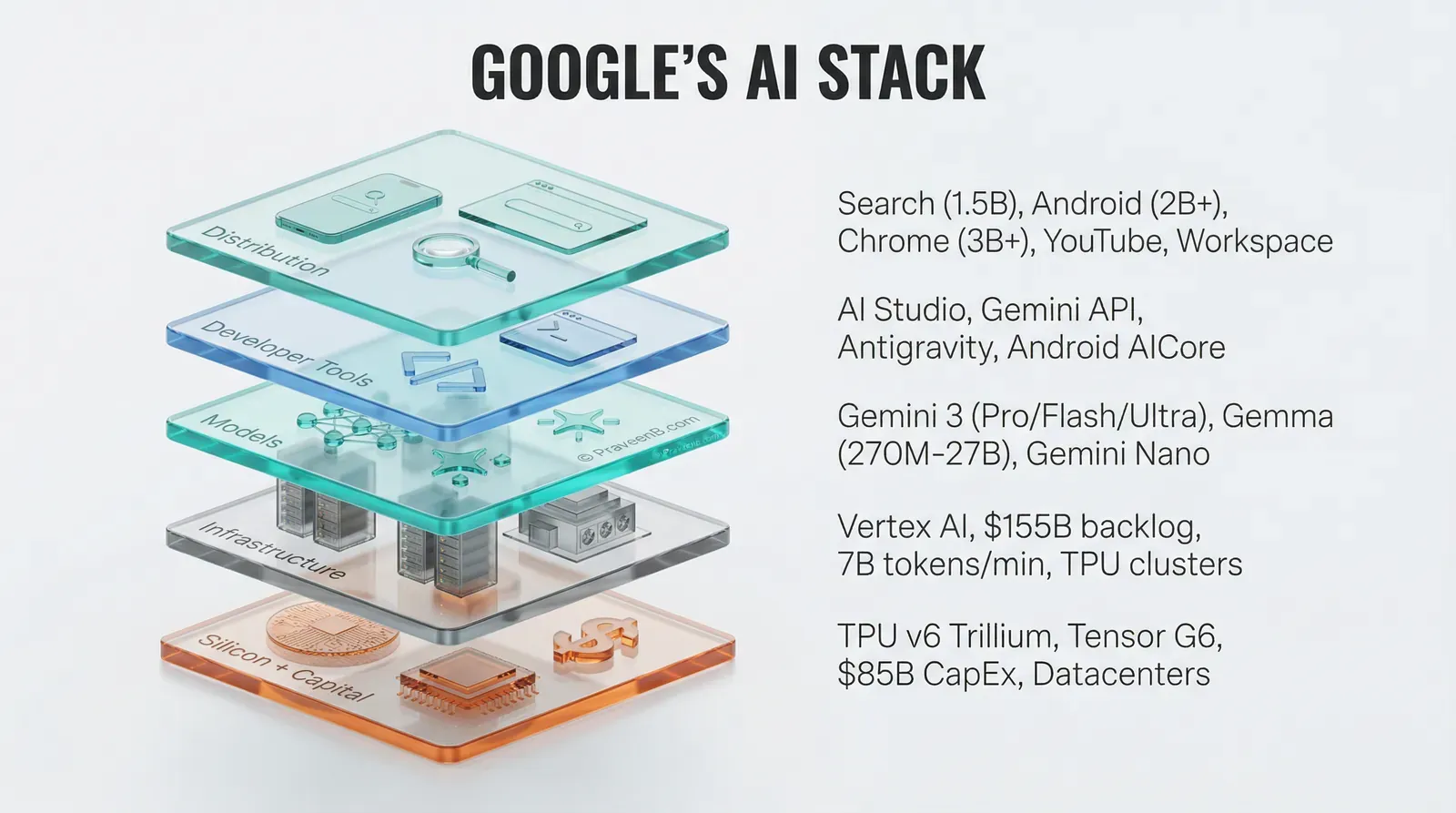
OpenAI had the model but depended on partners like Microsoft and Nvidia for everything else. When Apple needed a partner for 1.5 billion devices, they chose the company that could guarantee reliability and privacy at scale.
For startups, successes with leading brands is not a guarantee for future inroads with them. We need to nurture and grow our key accounts consistently and keep delivering value.
Anthropic chose a different game
While everyone fights over consumer distribution, Anthropic simply said "we're not playing that game."
They're projecting $70 billion in revenue by 2028. Not from consumers. From enterprise: Accenture, IBM, Deloitte, Cognizant. They launched HIPAA-ready Claude for Healthcare. They're training 30,000 Accenture professionals on their platform.
This is the lesson for founders. If you can't win distribution in one arena, find an arena where you can build the full stack. Anthropic isn't competing with Google for Apple's attention. They're competing for CIOs, CISOs, and CFOs. They changed the game and leaned into their strengths.
When you win a powerful logo
OpenAI had Apple. Until they didn't.
Not because ChatGPT got worse. They still have the market share and first-mover advantage. The problem was they didn't stabilize and build strong foundations with their existing client and align for larger mandates. When bigger opportunities were on the horizon, they didn't allocate critical time to nurturing the relationship.
For startup founders: when you close a powerful logo, it does not mean you can just throw a party, and coast for years. Even if a larger potential win is coming, you need to keep delivering value to your existing clients and partners. The moment you take a marquee account for granted, someone with a fuller stack is ready to take your place. BTW, definitely do the party, celebrating your wins is also always a good idea; but as your team celebrates, founders need to stay sober and have an eye on the future.
Apple goes back to first principles
I've always loved how Apple only focuses only on releasing products it can deliver really well. That's the reputation, anyway - let's pretend the Vision Pro and Apple Intelligence (or lack thereof) never happened.
But 2025 told a different story. Apple Intelligence was a mess. Delays, broken promises, a federal lawsuit over false advertising. The Vision Pro landed with a thud. The credibility gap that Apple built by announcing features nowhere near ready struck at the heart of their brand identity.
Now there's speculation about Tim Cook's exit in 2026, with hardware chief John Ternus as the likely successor. Apple even poached Amar Subramanya, a lead engineer from Google's Gemini team.
It feels like Apple is going back to first principles: admit what you can't build internally, find the right partner, and don't ship until it's ready.
It's never really written in the stars
So yes, Siri is now a Gemini.
And for founders watching this play out, the stars are clear: your planets might align early, but if you don't nurture the relationship and deliver full-stack value, someone else will.
I personally can't remember using Siri for anything meaningful apart from setting the occasional alarm. My iPhone's action button however, always has a shortcut mapped to whatever AI provider offering the best voice model. What about you?
Follow me on X for more thoughts on growth and strategy. Subscribe to my newsletter for new posts.
Sources
- Joint statement from Google and Apple
- Apple picks Google's Gemini to run AI-powered Siri - CNBC
- Sam Altman declares Code Red - Fortune
- Anthropic projects $70B in revenue by 2028 - TechCrunch
- 2025 will be remembered for what Apple didn't deliver - Macworld
- Apple succession plans for Tim Cook - Fortune